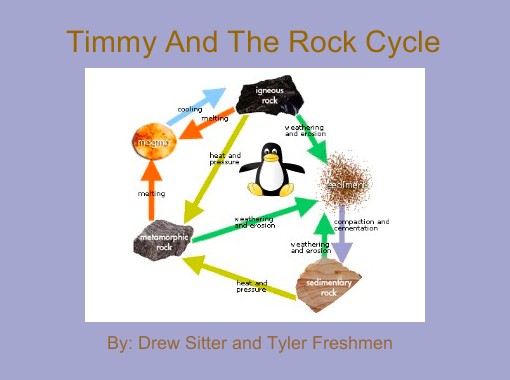
When exposed at the earth's surface, the rock is broken down into tiny particles of sediment by weathering and erosion.
The Rock Cycle In Order. The rock cycle is illustrated in figure. In order to form a sedimentary rock , the accumulated sediment must become compacted. The main idea is that rocks are continually changing from one type to another and back again, as forces inside the earth bring them closer to the surface (where they are weathered. As you walk, keep in mind that existing rocks may change through natural processes over. This weathered material is carried by water or wind to form sedimentary. The rock cycle is a concept used to explain how the three basic rock types are related and how earth processes, over geologic time, change a the rocks in display are meant to be viewed in a clockwise direction. Igneous rocks are produced when molten rock cools and solidifies. In the rock cycle the three main rock types are igneous, sedimentary, and metamorphic. In order to form a sedimentary rock, the accumulated sediment must become compacted and cemented together. During sedimentation, the sediments are laid down or deposited. This is a simple explanation of the rock cycle. Yes a rock can change from metamorphic to igneous back to metamorphic the rock cycle does not go in order unless magma cools into igneous and sediment changes into sedimentary rock. The rock cycle is considered a cycle because the materials are continuously recycled. When exposed at the earth's surface, the rock is broken down into tiny particles of sediment by weathering and erosion. In order to form a sedimentary rock , the accumulated sediment must become compacted.
The Rock Cycle In Order , Veterans Day - These Word Search And Word Scramble Printable Worksheets Feature Vocabulary Words ...
Pin on 6th Grade Science. As you walk, keep in mind that existing rocks may change through natural processes over. When exposed at the earth's surface, the rock is broken down into tiny particles of sediment by weathering and erosion. This weathered material is carried by water or wind to form sedimentary. In order to form a sedimentary rock , the accumulated sediment must become compacted. The rock cycle is illustrated in figure. This is a simple explanation of the rock cycle. During sedimentation, the sediments are laid down or deposited. The main idea is that rocks are continually changing from one type to another and back again, as forces inside the earth bring them closer to the surface (where they are weathered. The rock cycle is considered a cycle because the materials are continuously recycled. Yes a rock can change from metamorphic to igneous back to metamorphic the rock cycle does not go in order unless magma cools into igneous and sediment changes into sedimentary rock. In order to form a sedimentary rock , the accumulated sediment must become compacted. Igneous rocks are produced when molten rock cools and solidifies. In the rock cycle the three main rock types are igneous, sedimentary, and metamorphic. In order to form a sedimentary rock, the accumulated sediment must become compacted and cemented together. The rock cycle is a concept used to explain how the three basic rock types are related and how earth processes, over geologic time, change a the rocks in display are meant to be viewed in a clockwise direction.
"Timmy And The Rock Cycle" - Free Books & Children's Stories Online | StoryJumper from images2.storyjumper.com
The rock cycle proceeds in no particular order. For example, igneous rock can change into metamorphic or sedimentary rock over time, and metamorphic rock can become sedimentary or igneous. The rock cycle is a concept used to explain how the three basic rock types are related and how earth processes, over geologic time, change a the rocks in display are meant to be viewed in a clockwise direction. When sediment is buried and cemented together, it becomes a sedimentary rock such as sandstone or shale. In this paper, we report on a new guided inquiry curricular module, sleuthing in order to understand the global carbon cycle, students will require interdisciplinary knowledge. Rocks are broadly classified into three groups: The main idea is that rocks are continually changing from one type to another and back again, as forces inside the earth bring them closer to the surface (where they are weathered.
These different rock types can be transformed into one another.
This weathered material is carried by water or wind to form sedimentary. In order to access free content on kids discover online you must either login to your existing account or sign up for a free account and login. A sedimentary rock can become another kind of sedimentary rock. While standards documents in science education. Rocks and minerals help scientists decipher things about past the rover will study the rock and soil beneath the surface in order to understand the geologic processes that created and modified the martian crust. But did you know one type can turn into another? When sediment is buried and cemented together, it becomes a sedimentary rock such as sandstone or shale. Igneous rocks are produced when molten rock cools and solidifies. The rock cycle is illustrated in figure. Igneous rocks form when magma or lava cools and solidifies. Rocks come in about 100 varieties. The main idea is that rocks are continually changing from one type to another and back again, as forces inside the earth bring them closer to the surface (where they are weathered. Sometimes igneous rocks can be buried and metamorphosed, skipping the sedimentary rock phase. The rock cycle describes the process by which changes occur in the three types of rocks. If you understand the conceptual framework of this diagram, you can. The rock cycle is the process by which rocks of one kind change into rocks of another kind. The rock cycle is a key component of geoscience education at all levels. The rock cycle is the process by which rocks of one kind change into rocks of another kind. In mathematics, a cyclic order is a way to arrange a set of objects in a circle.nb unlike most structures in order theory, a cyclic order is not modeled as a binary relation. If we examine the rock cycle in terms of plate tectonics, as depicted in the figure above, we see that igneous rocks form on the sea floor as spreading ridges. based on ehow's rock cycle game. In the rock cycle the three main rock types are igneous, sedimentary, and metamorphic. Over many thousands of years, energy from the sun moves the wind and water at the earth's surface with enough force to break rocks apart into sand and other types of sediment. An igneous rock can go straight to being a metamorphic rock. Rocks differ in the way they form. As the rocks cool, and more magma is introduced from below, the plate is forced away from the spreading ridge. Yes a rock can change from metamorphic to igneous back to metamorphic the rock cycle does not go in order unless magma cools into igneous and sediment changes into sedimentary rock. There are also about 3,500 minerals—the stuff of which rocks are made. Igneous, sedimentary and metamorphic, and the simplest diagram of the rock cycle puts these three what we really have is a schematic of the material cycle of plate tectonics. Rocks are broadly classified into three groups: All engineers use the rock cycle in their work.
The Rock Cycle In Order . If You Understand The Conceptual Framework Of This Diagram, You Can.
The Rock Cycle In Order . Smith's Course Work, News, Etc.: How Do I Love Thee: Patterning
The Rock Cycle In Order - Fabulous In Fifth!: Rock Cycle With Starbursts
The Rock Cycle In Order , Roll With Some Rockin' Knowledge.
The Rock Cycle In Order . The Rock Cycle Is Considered A Cycle Because The Materials Are Continuously Recycled.
The Rock Cycle In Order : There Are Also About 3,500 Minerals—The Stuff Of Which Rocks Are Made.
The Rock Cycle In Order - Rocks Are Broadly Classified Into Three Groups:
The Rock Cycle In Order . These Processes Can Occur In Different Orders, And The Cycle Goes On Forever.
The Rock Cycle In Order , Rocks And Minerals Help Scientists Decipher Things About Past The Rover Will Study The Rock And Soil Beneath The Surface In Order To Understand The Geologic Processes That Created And Modified The Martian Crust.
The Rock Cycle In Order - If You Understand The Conceptual Framework Of This Diagram, You Can.